
Six intriguing position player trade candidates
If the Mariners pursue hitters at the deadline, here are a few names to consider.

The Mariners openly spoke about reaching the World Series during Spring Training. So, it’s reasonable to expect the team will look for ways to bolster an offense that ranked 26th in runs scored at the All-Star break.
Seattle’s run production challenges have been most acute against left-handed pitching with the lineup ranking near-or-at the bottom of baseball in multiple categories. That said, the Mariners haven’t exactly been lighting the world on fire against right-handed pitching when, at best, the offense has been average-ish.
With these deficiencies in mind, let’s discuss several hitters who piqued my interest. They possess different levels of talent, potential, and club control. A few notes:
Stats are through the All-Star Break.
There will be no trade cost/financial impact talk.
Every hitter is right-handed.
Players mentioned may not be available.
Casey Schmitt, INF/LF - Giants

Selling points: Schmitt’s 12.4-percent barrel rate is 35th best among 149 qualified hitters. The only Mariners better than the former second round pick are Luke Raley (16.1-percent) and Dominic Canzone (15.3-percent). Canzone is the lone Seattle player with a higher SLG (.529) than Schmitt.
In 100 plate appearances against left-handed pitching, Schmitt has a .330 AVG, .340 OBP, and .515 SLG. Paul Goldschmidt is the only right-handed hitter with a higher AVG versus southpaws than Schmitt.
This season, Schmitt has started games at every infield position and 29 contests in left field. Overall, Statcast rates him as an above average defender with a Fielding Run Value (FRV) of two. No Mariner has been better.
Fielding Run Value (FRV) Captures the overall measurable defensive performance of a player or team. It looks at range and throwing for fielders. For catchers: blocking, framing, and throwing are considered. ZERO is always average.
Potential concerns: Schmitt has a .332 OBP on the road and a .278 OBP at Oracle Park. Does this matter? Perhaps not. But it’s worth noting Statcast Park Factors considers just three MLB venues more pitcher-friendly than the Giants’ home field. One of them is Seattle’s T-Mobile Park.
Schmitt’s MLB-worst 2.4-percent walk rate helped produce a subpar .308 OBP, which would rank eighth among active Mariners.
Heliot Ramos, LF/RF - Giants

Selling points: Ramos also makes loud, quality contact. His 16-percent barrel rate is 14th best among 257 players with 200 plate appearances, just behind Raley.
The Puerto Rican is adept at punishing left-handed pitching (.906 OPS). But he’s also been decent against righties (.738 OPS). So much so, the 2024 All-Star doesn’t have to be in a platoon to provide value to an offense.
Potential concerns: In 2025, Ramos’ minus-11 FRV ranked last among 46 players with 200 innings as a left fielder. This season, his minus-2 FRV may not seem too bad. However, he’s only appeared in the field in 57 games due to a quad injury that cost him over a month of playing time.
Spencer Steer, 1B/2B/LF/RF - Reds

Selling points: The Oregon alum has 10-plus starts at first base, second base, and each corner outfield spot. He’s even started two contests in center field.
Steer has been a dynamic run producer against left-handed pitching with a .333 AVG, .436 OBP, .603 SLG, and a 179 wRC+.
Weighted Runs Created Plus (wRC+) quantifies how a hitter’s total offensive value compares with the league average after adjusting for park effects. League-average is always 100. Therefore, a wRC+ of 150 means a hitter was 50-percent more productive than the average player. An 80 wRC+ would be 20-percent below average.
Availability has been a positive for Steer. He’s averaged 153 games over the past three seasons and has appeared in 91 of Cincinnati’s 95 contests this year.
Steer would be one of the fastest runners on the current Mariners roster. His 28.5 feet-per-second sprint speed would trail only Julio Rodríguez (28.9), Víctor Robles (28.7), and Raley (28.6) on Seattle’s leaderboard.
Potential concerns: Steer has extreme platoon splits. The Californian has bashed southpaws (1.039 OPS). But he’s significantly less successful against righties (.650).
A similar disparity applies to Steer’s home and road numbers. At Great American Ball Park, he boasts a robust .808 OPS. Away from the Queen City, he’s produced a less impressive .685 OPS.
Taylor Ward, LF - Orioles

Selling points: Primarily a leadoff hitter with Baltimore, Ward has demonstrated a knack for reaching base. His OBP is 11th best - the byproduct of a fourth-ranked 17.1-percent walk rate.
As Ward walked more frequently in 2026, swing and miss declined. In fact, just ten hitters have reduced their strikeout rate more than his 5.7-percent drop off.
Ward has also feasted on lefty pitching (.891 OPS) with a playable .695 OPS versus right-handers.
The Ohioan has experienced reverse home and away splits. His .672 OPS at Oriole Park at Camden Yards is significantly lower than what he’s delivered away from Baltimore’s home field (.828).
Potential concerns: The Fresno State product has just six home runs after hitting 36 bombs in 2025. Moreover, his 5.6-percent barrel rate is 8.1-percent lower than it was last season.
Defensively, Ward rates as a below average left field glove with minus-2 FRV.
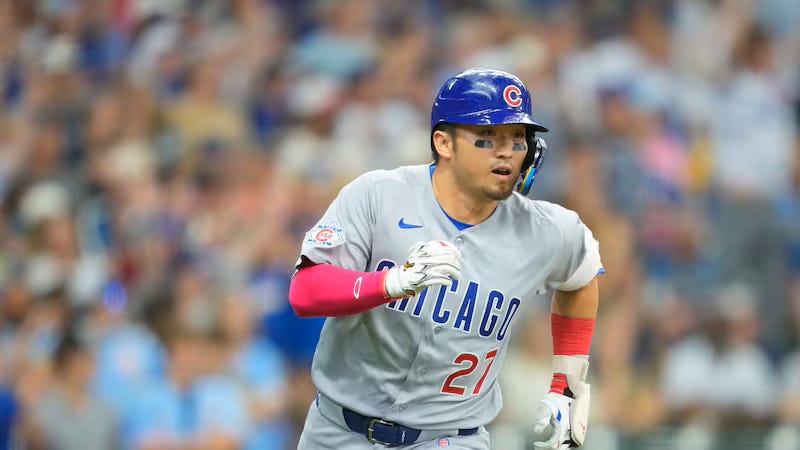
Seiya Suzuki, RF - Cubs

Selling points: The native of Japan has been amazingly consistent at the plate throughout his big-league career. To see what I mean, compare Suzuki’s 2026 numbers to what he’s done since joining the Cubs four years ago.
Seiya Suzuki’s Predictably Strong Numbers
2026: .268 AVG, .347 OBP, .464 SLG, 123 wRC+
Career: .269 AVG, .346 OBP, .471 SLG, 126 wRC+
Among 39 players with 200-plus innings in right field, Suzuki’s 5 FRV ranks second behind Boston’s Wilyer Abreu.
Suzuki mashes left-handed pitching (.927 OPS). Even better, he has an above-average .767 OPS versus right-handers.
Potential concerns: Even though the metrics like Suzuki’s defense this year, it’s critical to point out his FRV hasn’t been as palatable in previous campaigns. This likely explains why the 31-year-old started 102 games at designated hitter in 2025.
Suzuki’s FRV
2022 (-3)
2023 (-2)
2024 (-3)
2025 (-1)
2026 (5)
Suzuki has been noticeably more productive at Wrigley Field than away from the historic landmark this year.
Suzuki’s Home/Away Splits (2026)
Home: .281 AVG, .382 OBP, .489 SLG, .871 OPS
Away: .258 AVG, .315 OBP, .442 SLG, .756 OPS
To be fair, Suzuki’s career .833 OPS on the road is 34 points higher than what he’s produced in the Windy City.
Curtis Mead, 1B/2B/3B - Nationals

Selling points: After producing a 77 wRC+ in 488 plate appearances over three previous seasons, Mead is enjoying a breakout campaign. In fact, the Australian would rank third-or-better among regular Mariners in home runs, OBP, SLG, and wRC+.
This year, Mead is making significantly more quality contact than he’s done previously. His hard-hit rate is up nearly eight points to 42.6-percent, while barreled balls have climbed over six points to 11.9-percent. Furthermore, Mead has nearly doubled his walk rate and cut strikeouts by five percent.
Mead has demonstrated in the first half of the 2026 campaign that he can produce against any pitcher, regardless of their handedness. When facing lefty hurlers, the 25-year-old has an .869 OPS. Against right-handers, his .824 OPS is 16th best among right-handed hitters.
Mead also boasts the ability to play multiple positions. This season, he’s played 30-plus games at each corner infield spot and has appeared at second base six times.
Potential concerns: Mead’s success thus far is a relatively small sample. Plus, he’s the youngest and least experienced player we’ve discussed.
Mead is taking full advantage of playing home games at Nationals Park, a venue considered more favorable to hitters than pitchers. This becomes evident when we review his home and away splits.
Curtis Mead’s Home/Away Numbers (2026)
Home: .262 AVG, .354 OBP, .553 SLG, .907 OPS
Away: .229 AVG, .326 OBP, .441 SLG, .767 OPS
Just to be clear, Mead’s road numbers are still respectable. But not nearly as noteworthy as what he’s done when playing at home.
From a defensive standpoint, Mead’s minus-7 FRV ranks 90 of 95 infielders with at least 500 innings, tying him with Seattle’s J.P. Crawford. For those wondering, Mead is near the bottom of the pool at first base and the hot corner, too.
Thoughts
If forced to prioritize the names we’ve discussed, I would choose Schmitt first followed by Suzuki, Ward, Ramos, Steer, and Mead. The combination of Schmitt’s excellent positional versatility, solid offensive numbers, and club control stands out most to this nerd.
Even if underperforming Cal Raleigh and Josh Naylor rebound in the second half, the Mariners would benefit from Suzuki’s offensive consistency over the final two months of the 2026 campaign. That said, I struggle to see why the win-now Cubs would trade one of their best hitters.
As ironic as the idea may seem, perhaps Ward’s power flourishes if he’s playing home games in Seattle rather than Baltimore. Even if the pop in his bat doesn’t return, his superb on-base ability would be valuable.
Acquiring Ramos would represent an upgrade for Seattle’s underperforming offense. That said, adding another defender who rates very poorly to one of the worst defensive clubs in MLB may be a bridge too far for management.
Steer’s ability to move around the field is intriguing. But offensive expectations should be tempered considering he’s played his entire career at the bandbox known as Great American Ball Park. Adapting to T-Mobile Park in the middle of a playoff chase might be a big ask.
As mentioned earlier, Mead has enjoyed a breakout year through the All-Star break. Can he sustain it? That’s a question we can’t answer. Therefore, any contender acquiring him prior to the upcoming deadline assumes a great deal of risk at the most critical point in the season.
Finally
Whether any of these players actually make sense to the Mariners is unclear to this blogger. Having said that, it will take more than acquiring an established bat for this club to get where it wants to go.
Realistically, the majority of the lineup’s core - Rodríguez, Raleigh, Naylor, and Crawford - must produce closer to its career norms to give Seattle a fighting chance of reaching the Fall Classic.
My Oh My…