
Nico Hoerner and the Mariners?
A hitter with great on-base ability, who is also a disruptor on the bases and a top-shelf defender? Sign me up.

Not long ago, we considered second base trade candidates for the Mariners. Players included in our conversation were Jake Cronenworth, Brandon Lowe, Ketel Marte, Brendan Donovan, and Jeff McNeil. But a lot has changed since early December.
Lowe and McNeil have since been traded, while Ken Rosenthal and Maria Torres of The Athletic report Marte is off the market. Of the two remaining players from our original list, only Donovan makes sense for Seattle from a performance, roster, and organizational perspective. But what if the Mariners and Cardinals cannot agree to terms on a deal that brings Donovan to the Pacific Northwest?
Just today, Adam Jude of The Seattle Times suggested another established name the Mariners could possibly pursue. Someone the team has reportedly expressed interest in during previous winters - Nico Hoerner of the Cubs. Let us consider what makes Hoerner an intriguing option.

Selling points: A main component of Hoerner’s offensive value is his ability to reach base. Dating back to the beginning of the 2023 campaign, the Stanford product boasts a .342 OBP. Notable big-leaguers reaching first base at a similar clip include Mariners Randy Arozarena and Josh Naylor, plus All-Stars Francisco Lindor, George Springer, and Corbin Carroll.
Taking a lot of free passes is not how Hoerner manages to get on base so often. He had a below-average 6-percent walk rate last year. Instead, his specialty is making contact. Only two of 145 qualified hitters produced a lower strikeout rate than Hoerner did in 2025. They were Luis Arráez (3.1-percent) and Jacob Wilson (7.5-percent).
If Hoerner happened to be dealt to the Mariners this offseason, it’s difficult to confidently predict how he might perform in baseball’s most extreme pitcher’s park. But according to Statcast, only Seattle’s T-Mobile Park suppressed right-handed offense more than Chicago’s Wrigley Field over the past three seasons. Yet, Hoerner produced a .282 AVG and .341 OBP at home during this period.
Hoerner’s 28.6 feet-per-second sprint speed tied for 29th best among 186 players with at least 150 competitive runs. This quickness undoubtedly contributed to his 29 stolen bases in 2025. The only Mariner with a better sprint speed than the 24th overall draft pick in 2018 was Julio Rodríguez (29.2 feet-per-second).
Sprint Speed is a Statcast product that measures how many feet-per-second a player runs in his fastest one-second window. The MLB average is 27 feet-per-second.
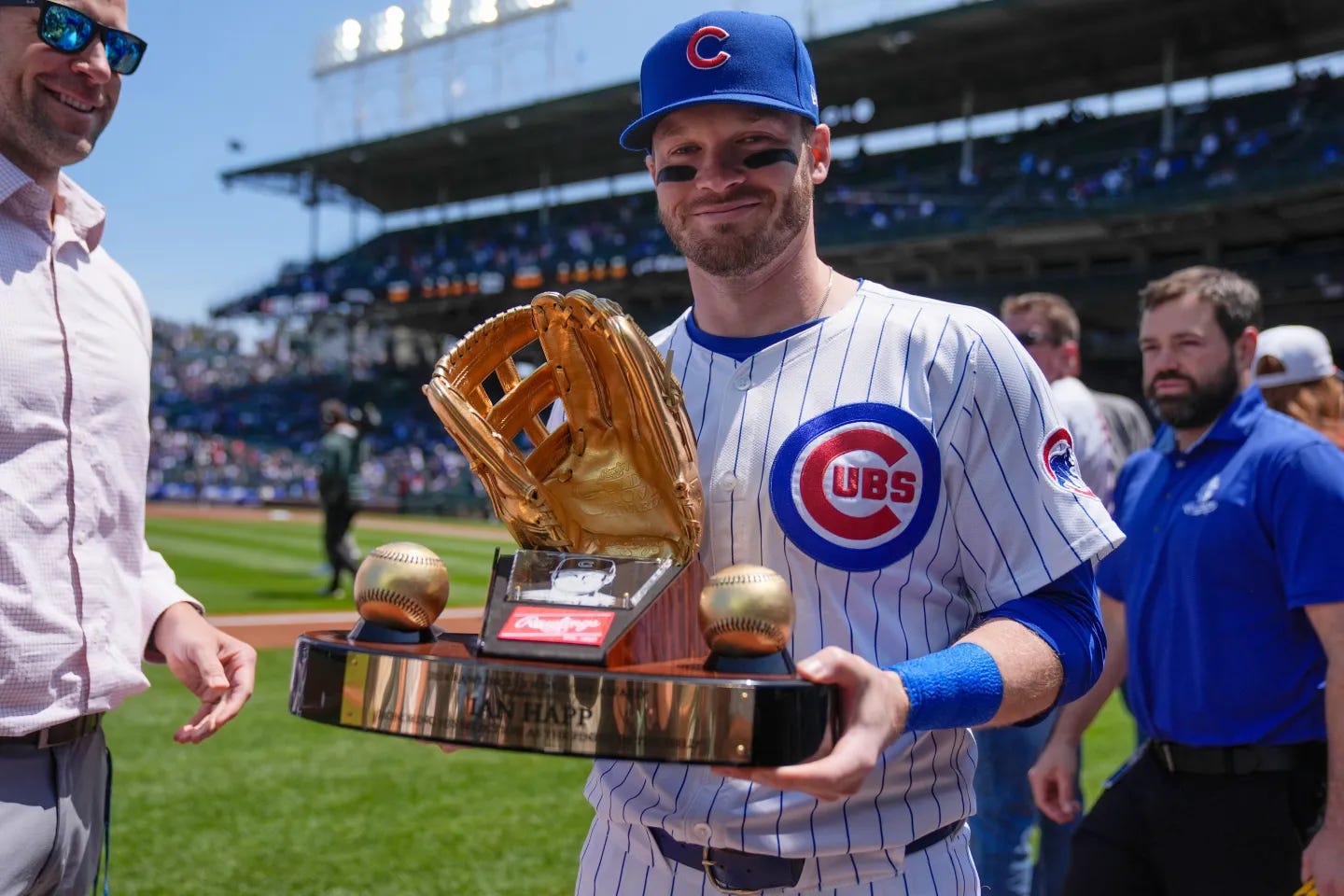
Hoerner won his second Gold Glove last year. Even better, the metrics support the selection. The Oakland, California native’s Fielding Run Value (FRV) of 13 tied for 10th best among all defenders and was tops among second basemen. Conversely, Cole Young accrued minus-7 FRV in 621 innings at the keystone for the Mariners during his rookie season.
Fielding Run Value (FRV) is Statcast's metric for capturing a player’s overall measurable defensive performance. ZERO is always average.
Although he was primarily a second baseman with the Cubs last year, Hoerner did play three complete games and cover 37 innings at shortstop. It’s worth noting he was Chicago’s regular shortstop until Dansby Swanson signed with the team after the 2022 campaign. During Hoerner’s last full year at shortstop, his 10 FRV was third best behind the MLB-leading Swanson.
Potential concerns: Hoerner puts the ball in play, but it’s unlikely to be loud, quality contact. Last year, his 30.3-percent hard-hit rate was 10th lowest among those 145 qualified hitters. Similarly, just five players had a lower barrel rate than the 2.3-percent produced by the 28-year-old. This helps explain the fact just four qualified hitters had fewer home runs than Hoerner in 2025.
Over the past three seasons, Hoerner has averaged 152 games annually. But before 2023, he did deal with a variety of maladies that negatively affected his availability. Issues included ankle, oblique, hamstring, and rib injuries. Furthermore, the Head-Royce School alum underwent offseason flexor tendon surgery in October 2024.
Perhaps the flexor injury explains the decrease in Hoerner’s arm strength over the past four seasons. In 2022, his throws averaged 85.3 mph - 19th best among shortstops. By last year, that velocity was down to 75.5 mph, which ranked 58th of 67 second basemen.
Thoughts: If today was Opening Day, the Mariners would likely begin the season with Young and fellow second-year player Ben Williamson at second base and third base respectively. It’s also plausible Leo Rivas and prospects Colt Emerson and Michael Arroyo work their way into the mix during Spring Training. Still, adding an established infield starter between now and March 26 makes so much sense to this nerd.
If Donovan turns out to be unavailable or ends up with another team, Hoerner would be a wonderful alternative. He reaches base often and is a superb base runner with elite-level defensive skills. This combination should trump any power deficiencies. Furthermore, playing in 94-percent of his club’s games since 2023 signals excellent durability.
Still, I struggle to envision the Cubs moving Hoerner this offseason. Chicago has been aggressively buying this offseason. Why would a club with World Series aspirations trade a player of Hoerner’s ilk now?
Then again, stranger things have happened.
My Oh My…