
Mariners Preview: Defense
Defense wasn't a strength for Seattle in 2025. Does it improve this year?

Mike Petriello of MLB recently projected the top defensive teams for the upcoming season. Petriello didn’t have the Mariners among the best in baseball. But he did classify Seattle as a “top 5 improver” that would be a “little closer to average in 2026.”
Based on last season’s metrics, placing somewhere near the middle would be a tremendous improvement for the Mariners. Using the Statcast product Fielding Run Value (FRV), the team’s defense ranked 26th. It couldn’t get much worse.
Fielding Run Value (FRV) Captures the overall measurable defensive performance of a player or team. It looks at range and throwing for fielders. For catchers: blocking, framing, and throwing are considered. ZERO is always average.
Five Seattle position groups placed in the bottom-third. Corner infielders and corner outfielders were 29th and 30th respectively.
Mariners Position Group FRV Rankings
Overall (26th)
1B (21st)
2B (27th)
SS (28th)
3B (18th)
LF (22nd)
CF (13th)
RF (26th)
C (13th)
Middle IF (29th)
Corner OF (30th)
Petriello believes the Mariners got better by moving on from poorly-rated fielders Rowdy Tellez, Jorge Polanco, Mitch Garver, and Dylan Moore. Throw Leody Taveras into that pile. All told, this group combined for minus-19 FRV last year.
Another way the Mariners’ defense can make progress is with “small upgrades,” as Petriello put it. With this in mind, let’s cover my outlook for each position. Along the way, we’ll discuss the new guys and holdovers.
First base - Improved
Josh Naylor accrued 1 FRV after joining the team in July. It’s worth mentioning Naylor was minus-2 FRV with the Diamondbacks before becoming a Mariner. But that number may be an outlier. In three previous seasons with the Guardians, the Canadian averaged 2 FRV annually.
Luke Raley (minus-1 FRV at first base) will play in the outfield. But he could be a contingency behind Naylor.
Bottom line: As long as Naylor is available, first base defense should be in the black this year.
Second base - Improved
Petriello expects Cole Young to overcome a difficult rookie season when his minus-7 FRV ranked 26th of 27 second baseman. Makes sense considering the first rounder played three times as many innings at shortstop than second base before making his big-league debut.
Young’s Minor-League Workload
Second base: 78 games - 652.2 innings
Shortstop: 241 games - 2,086.1 innings
A little extra perspective: Young’s 621 innings at the keystone with Seattle almost exceeded his minor-league career total at the position.
A torn bicep cost last year’s Opening Day second baseman, Ryan Bliss, most of the 2025 campaign. The 26-year-old has made six starts at second base during Spring Training. Dating back to 2024, Bliss has 3 FRV in 276 innings as a second baseman.
Bottom line: Young is just 22, highly athletic, and extremely talented. Plus, esteemed infield coach Perry Hill is overseeing his development. Therefore, his defensive metrics should look much better in 2026 and beyond.
Shortstop - Status quo (suboptimal)
Last season, Toronto’s Bo Bichette (minus-10 FRV) was the lone shortstop worse than J.P. Crawford (minus-9). It should be noted that when the Mets signed Bichette in January, the team introduced him as their everyday third baseman.
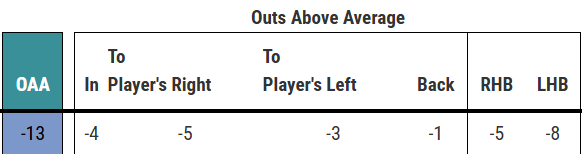
Range is the factor driving Crawford’s poor rating among shortstops. We can see this when we review his Outs Above Average (OAA) - a range-based metric that gauges how many outs a defender saved.
Crawford’s minus-13 OAA tied for last with Bichette. The following illustrates his range was below average in three directions last season - coming in on balls, going to his right, and moving to his left.
Crawford recently received treatment for a shoulder issue, which casts doubt on his Opening Day readiness. If the 10-year veteran misses time, I suspect Leo Rivas takes over. When Rivas covered for an injured Crawford in 2024, he registered minus-2 FRV in 180 frames.
Young could also make sense for a short period. But I suspect the Mariners would prefer having the sophomore settle in at second base so he can master the position.
Perhaps Colt Emerson is an option, although I tend to believe management would rather keep the top-10 prospect in the minors a bit longer. That’s just a hunch based on the organization’s previous approach with other promising players.
Bottom line: Over the past four seasons, Crawford has averaged minus-6 FRV annually and he’s now 31. Never say never, but it’s unlikely this position improves with the incumbent remaining in place.
Third base - Improved
Newcomer Brendan Donovan represents one of those small upgrades. During his four-year career, Donovan has primarily played second base and left field. The versatile defender played 809 innings at second base last year, which is three times his career total at third base (272).
Still, Donovan’s career FRV at third base is encouraging - even if it’s based on a small sample.
Donovan’s Career FRV
Second base (1)
Third base (2)
Left field (minus-5)
Bottom line: How long Donovan remains the everyday third baseman probably hinges on the development of Young and Emerson. If Young falters, which I don’t expect, Donovan could slide over to second base. Once the team decides the 20-year-old Emerson is ready for primetime, he could possibly take over the hot corner with Donovan moving around the diamond based on matchups.
Right field - TBD
It’ll be interesting to see how the tandem of Raley and Víctor Robles perform. Since both players dealt with injuries, let’s focus on the four campaigns prior to 2025.
Overall, Raley had minus-3 FRV between 2021 and 2024. But in 643 innings as a right fielder, he was average (ZERO FRV) with the Dodgers, Rays, and Mariners. As for Robles, he accrued 7 FRV as an outfielder during the same period with most of his time being served in center field. In 248 right field innings, he accrued 2 FRV.
Designated hitters Dominic Canzone and Rob Refsnyder have previously played left field. But manager Dan Wilson has exclusively used them as DH or in right field during Cactus League action this year. In over 900 innings as a right fielder dating back to 2023, Canzone rates poorly with minus-7 FRV. During the same timeframe, Refsnyder is minus-1 in 394 frames.
Bottom line: If Raley and Robles remain healthy and viable, they can drive a substantial improvement. After all, simply being average would be dramatically better than last season. How often Canzone and Refsnyder play right field matters, too.
Left field - Status quo (suboptimal)
Petriello assumes Randy Arozarena may play more designated hitter, which would help the team’s fielding numbers. Last year, Arozarena ranked 20th among 25 left fielders. Since 2023, he’s averaged minus-7 FRV each year.
The sample is small, but I will share it anyway. Canzone was average during 134 innings as a left fielder in 2024. That said, an early-season collision with the T-Mobile Park left field wall resulted in a month-long IL stint.
Bottom line: Maybe time proves this nerd wrong. But it’s tough envisioning the Mariners significantly reducing Arozarena’s outfield time. If I’m correct, the position remains underwater from a metrics standpoint.
Center field - Status quo (still great)
Julio Rodríguez, whose 10 FRV tied for sixth best among center fielders, was Seattle’s lone Gold Glove finalist.
Robles played a lot of center field in Arizona during Rodríguez’s participation in the World Baseball Classic. And even though his defense has slipped in recent years, Robles has been an average center fielder in limited opportunities with Seattle.
Bottom line: If Rodríguez were absent for a short period, Robles could hold down the fort, defensively. But if the 2022 AL Rookie of the Year was out for an extended period, things could get challenging.
Catcher - Status quo (still great)
One season removed from being a Platinum Glove Winner, Cal Raleigh continued to be an above-average defender.
Andrew Knizner was signed in December to serve as Raleigh’s backup. In five seasons and just over 1,800 innings with the Cardinals, his pitch framing ranked 66th of 68 catchers. But the 31-year-old’s framing has improved considerably since. In 2024-25, Knizner was slightly above average in 473 innings with the Rangers and Giants.
The minus-7 FRV of non-roster invite Mitch Garver was solidly subpar during his two years with Seattle. Still, familiarity with the pitching staff and extensive big-league experience could factor into whether he remains a Mariner. But being 35 may work against him, too.
Bottom line: No one is replacing Raleigh’s defense and leadership. But Knizner could potentially lessen the blow of losing the All-Star receiver from a defensive standpoint.
Well?
When Petriello posted his story, I was somewhat skeptical of the Mariners improving enough to be mid-pack in 2026. But after walking through each position, I can see a path leading the defense back to respectability.
Seattle’s metrics would possibly improve even more without Crawford and Arozarena playing in the field every day. But, as we all know, defense is just one of many pieces in the puzzle.
The offensive capabilities of Crawford and Arozarena matter. So as long as they’re healthy and their bats are productive, they likely remain defenders. Then again, a prolonged slump could potentially lead to a reduced role for either popular veteran.
My Oh My…